Menu
Call This Friday to Get $50 Off
Do You Need a Plumber in Dallas, TX? Call us Now to Get $50 OFF
4.8 / 5 Ratings based on 1384 reviews Great Plumbers, Great Reviews

Call This Friday to Get $50 Off


Underground pipes spend decades under pressure, shifting soil, root systems, and corrosive conditions that never let up. The failures that result rarely show up with much warning above ground. Mr. Rooter Plumbing can help. Keep reading to see what breaks down a buried pipe and which warning signs are worth paying attention to.
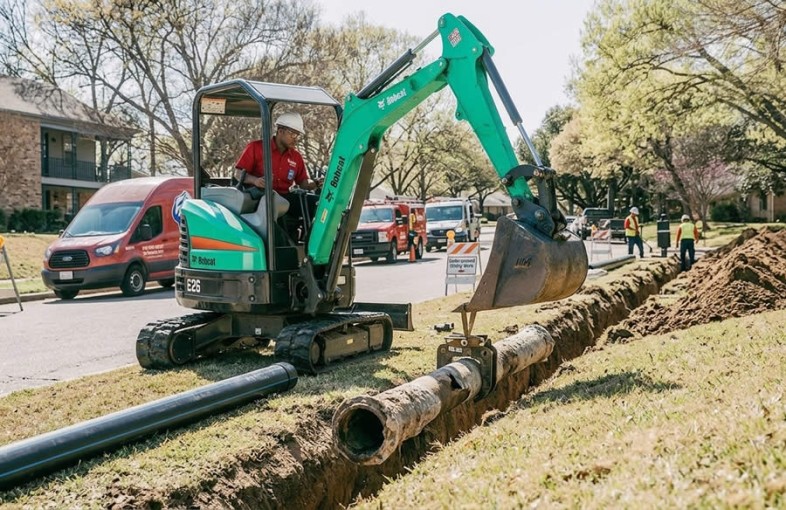
The pipe running beneath your yard is not a permanent fixture. Every material has a lifespan that depends heavily on what the pipe is made of and what it was up against from day one.
Cast iron and galvanized steel were the standard for most of the twentieth century. They hold up well under load, but both corrode from the inside out as mineral deposits accumulate and oxygen interacts with the metal. Galvanized pipe typically begins to show internal restrictions after 40 to 50 years. Cast iron can last longer, but once it begins to pit and crack, the deterioration accelerates quickly. Orangeburg pipe, a mid-century product made from compressed tar and wood pulp, was never built for longevity and tends to collapse inward as it absorbs moisture.
PVC and ABS plastic pipes, introduced more broadly in the 1970s and 1980s, resist corrosion far better than their metal predecessors. But plastic is not immune to failure. UV exposure degrades surface sections, and burial in acidic soil causes some plastics to become brittle at the joints. A licensed plumber assessing an older system will look at the pipe material first because it can help reveal the failure mode.
Soil is not static. It expands when wet, contracts when dry, and shifts when temperature cycles freeze and thaw the ground repeatedly. Pipes buried in this environment absorb that movement, whether they are designed to or not.
Clay soils are particularly aggressive. They swell when saturated and pull away during dry periods. A pipe running through expansive clay can experience repeated lateral stress across its full length, which eventually cracks the barrel or separates the joints. Sandy or poorly compacted soil settles unevenly and leaves sections of pipe without enough support underneath. Unsupported sections sag and create low points where water and debris collect.
Seismic activity, heavy surface traffic, and nearby construction also contribute. Ground vibration from heavy equipment travels through the soil and concentrates stress at the weakest point in a buried line. Plumbing repair service calls following road work or construction in residential neighborhoods are not coincidental. The pipe was already under stress, and the added vibration pushed it past the point of tolerance.
The barrel of a pipe is the strongest part of the system. The joints connecting each section rely on sealants, rubber gaskets, or threaded connections to hold pressure and maintain alignment, and all three of those mechanisms degrade faster than the pipe.
Rubber gaskets dry out and lose elasticity as the ground temperature fluctuates across seasons. Once a gasket fails, the joint no longer seals under pressure. Water begins escaping into the surrounding soil, which softens the bedding material and allows the pipe to shift further. That applies new stress to the next joint down the line, and the failure spreads incrementally.
Threaded metal connections corrode at the thread, which is the thinnest point of the wall. Tree roots that are drawn toward moisture locate failing joints before surface symptoms appear. If caught early, a professional pipe repair at a joint failure can resolve the problem without disturbing the surrounding pipe. When it’s left alone, joint failures will eventually require excavation and a full section replacement.
Tree roots follow moisture. Any pipe carrying water produces enough condensation and minor seepage to attract root growth, and roots will find the smallest imperfection in a pipe wall and exploit it.
Fine feeder roots enter through hairline cracks and deteriorating joints. Inside the pipe, they expand as the tree grows and fill the diameter of the line. The root mass catches debris, restricts flow, and increases internal pressure. As the root continues to grow, it physically cracks the pipe from the inside. Once a homeowner notices a slow drain or gurgling in the fixtures, the root intrusion has usually been progressing for years.
The species of tree is important. Willows, silver maples, and cottonwoods produce aggressive, water-seeking root systems and cause damage at greater distances from the tree. An experienced plumber using a camera inspection tool can identify root intrusion without excavation, and early-stage intrusions can be cleared mechanically before structural damage occurs. Waiting until the flow stops completely usually means the pipe wall has already fractured.
Underground pipe failures announce themselves inside the house before the pipe gives out. Most homeowners attribute these signals to minor plumbing issues and delay calling for service, which allows the underlying problem to worsen. Watch for these specific changes in your home's plumbing behavior:
A wet spot or sinkhole forming in the yard without recent rain is the most urgent sign. That indicates active soil erosion caused by a pipe leak, and the cavity beneath the surface is expanding. Contact a plumbing repair service immediately at that stage.
Buried pipes normally fail because of material decay, soil movement, joint failure, root intrusion, and water chemistry damage. A camera inspection can locate the problem before excavation becomes necessary. Early pipe repair costs a fraction of what a collapsed or fully blocked main line costs to restore. Mr. Rooter Plumbing provides professional diagnosis and repair work backed by experienced plumbers who know how to protect your property during the process. Call today to schedule a camera inspection and find out what your pipes look like before the warning signs move above ground.
Underground pipes spend decades under pressure, shifting soil, root systems, and corrosive conditions that never…
Read More+
If your basement takes on water after heavy rain, it can quickly lead to mold,…
Read More+
Kitchen cleanup moves faster when everything under the sink is working the way it should.…
Read More+
Pictures and descriptions only go so far, but real results from
Read More+