Menu
Call This Friday to Get $50 Off
Do You Need a Plumber in Dallas, TX? Call us Now to Get $50 OFF
4.8 / 5 Ratings based on 1384 reviews Great Plumbers, Great Reviews

Call This Friday to Get $50 Off


Most homeowners have no framework for recognizing underground gas line damage until conditions have already deteriorated. At Mr. Rooter Plumbing, our plumbing repair service team responds to gas line concerns regularly. The homeowners who call early normally have much better outcomes than those who wait. Knowing what to watch for can help you avoid serious hazards. Keep reading to find out what the warning signs look like and when it is time to call for gas line repair.
Natural gas is odorless in its natural state, so utility companies add mercaptan, a sulfur compound, to give it a distinctive rotten-egg smell. If you catch the odor near your yard, along your foundation, or anywhere near a gas meter, treat it as an emergency. Don't stop to investigate, don't flip light switches, and don't try to locate the source yourself.
Leave the building, move a safe distance away, and call your gas utility from outside. Once the utility has assessed the immediate risk, contact a licensed plumber to inspect the line and determine the extent of the damage. Gas leaks near the foundation can migrate into your home through cracks, crawl spaces, and utility penetrations, where they accumulate to dangerous concentrations.
The smell doesn't have to be overwhelming to be serious. A faint, intermittent odor that comes and goes near the same area of your yard is worth reporting every time. If neighbors mention the same smell around the same time, that narrows the source and makes the case for immediate action even stronger.
A patch of grass that dies in a straight line or a cluster of shrubs that wilt without a cause deserves a second look, especially if it sits above where your gas line runs. Leaking gas displaces soil oxygen, which starves root systems and kills plant life. Healthy grass on either side with a dead strip running through the middle is a reliable sign of subsurface gas exposure.
This sign is easy to miss because homeowners assume it’s just drought stress, pest damage, or disease. The difference is in the shape and location. Drought damage spreads unevenly across a lawn. Gas damage typically follows a linear path and doesn't respond to watering or treatment.
If you notice vegetation dying in a line above your utility corridor, mark the area and call for a plumbing repair service inspection before you dig, aerate, or plant anything in that zone. Disturbing the soil above a compromised line can worsen the leak and increase the risk of ignition.
Soil settling, heaving, or unexpected soft spots in your yard can all indicate underground line damage. A gas leak that’s present for weeks or months can dry out and destabilize the surrounding soil. Sometimes it creates depressions or raised areas above the line. Frost heave and seasonal shifts can also crack older lines, and the resulting ground disturbance is one of the first physical signs to appear.
Bubbling in standing water after rain is another indicator. If puddles in your yard produce small bubbles without any rain, gas may be escaping through the saturated soil and pushing up through the water. This is distinct from normal runoff behavior and easy to spot if you know what you're looking for.
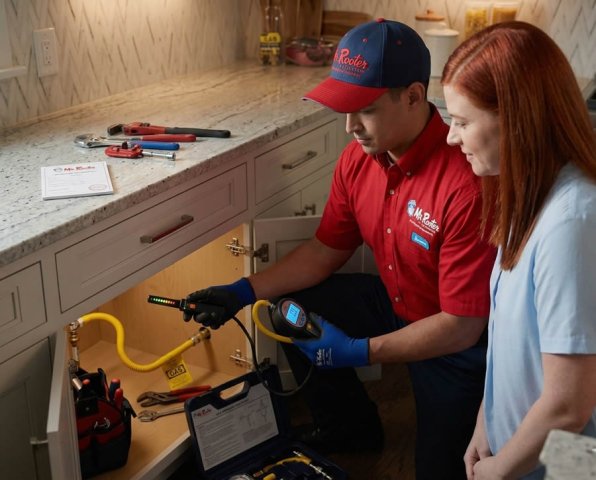
Any unexplained change to the ground surface directly above your gas line route needs a professional assessment. A qualified plumber with the right detection equipment can test for gas presence without opening the ground unnecessarily. Combustible gas detectors, pressure testing, and line tracing tools let technicians locate a leak precisely before excavation begins.
A gas bill that spikes without reason is one of the quieter warning signs homeowners dismiss too quickly. If your heating and appliance use hasn't changed, but your bill jumped 20 to 30 percent or more, gas may be escaping before it reaches your appliances.
Underground leaks don't always produce a detectable smell at the surface, particularly in dry soil or at greater depths. The meter, however, still registers the gas moving through the line. You pay for gas your household never used, and the discrepancy shows up in your billing each month until someone investigates.
Pull two or three months of bills and compare usage in similar seasons from prior years. A consistent upward trend without explanation is enough reason to schedule a gas line repair inspection. If your utility can't identify a meter or rate issue on their end, the problem is probably downstream, inside your lines. Catching a leak through billing data is much less dramatic and destructive than discovering it through physical damage.
If you detect a rotten-egg smell, see dying vegetation above your line, notice ground disturbances, or can't explain a sudden increase in your gas bill, contact a local plumber right away. Each of these signs, on its own, justifies a professional inspection. Together, it means you need a gas line repair. At Mr. Rooter Plumbing, our plumbing repair service is available when you need it. We inspect, diagnose, and repair underground gas lines with the equipment and experience to do it safely. Call us today and let us take a look before there’s an emergency.
Most homeowners have no framework for recognizing underground gas line damage until conditions have already…
Read More+
Stepping onto a warm patch of floor on a cold morning might seem like a…
Read More+
Underground pipes spend decades under pressure, shifting soil, root systems, and corrosive conditions that never…
Read More+
If your basement takes on water after heavy rain, it can quickly lead to mold,…
Read More+