Menu
Call This Wednesday to Get $50 Off
Do You Need a Plumber in Dallas, TX? Call us Now to Get $50 OFF
4.8 / 5 Ratings based on 1384 reviews Great Plumbers, Great Reviews

Call This Wednesday to Get $50 Off


A garbage disposal leaking from the base has already failed internally, and no reset button or cleaning cycle will change that. Mr. Rooter Plumbing pulls corroded units out of Dallas kitchens every week, and the story is almost always the same. The homeowner waited months past the point where replacement made sense. Garbage disposal replacement costs far less than the water damage that follows when a corroded unit finally gives out completely. If your disposal has been humming, stalling, or leaking, this post will show you what's happening inside it and what to do next.
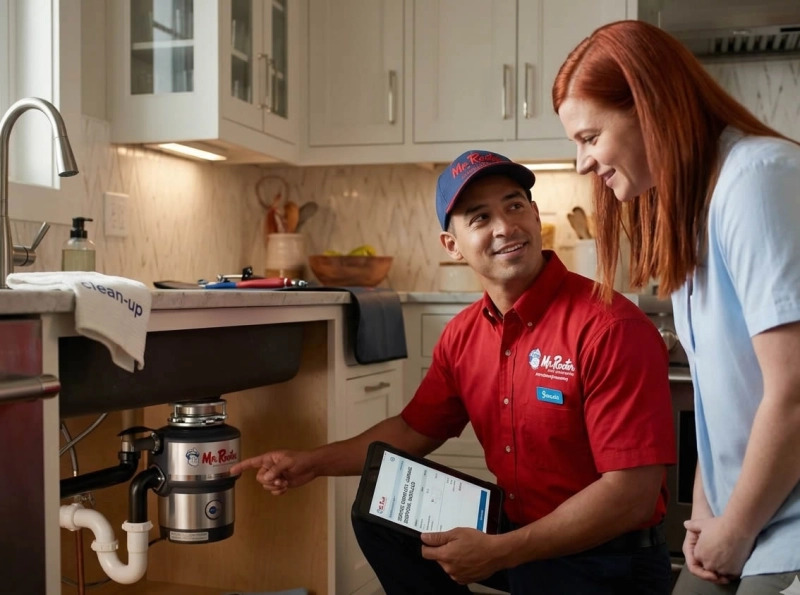
Most homeowners picture corrosion as something that happens on the outside of old pipes. Inside a garbage disposal, it works differently. The grind chamber sits in a near-constant cycle of moisture, food acids, and metal contact, which breaks down the interior finish.
Citrus rinds, coffee grounds, and food scraps all release mild acids during grinding. Those acids eat at the protective coating on the impeller plate and grind ring. Once the coating breaks down, bare metal sits exposed to standing moisture between uses, and rust develops in layers. A unit in this condition degrades gradually until the corroded metal can no longer hold a seal, and water finds a path out through the base.
Grease makes the problem worse. It coats the interior walls and traps food against the metal, which accelerates breakdown in the spots that already took the most wear. Once you notice a leak or a persistent smell, no amount of cleaning will remove it. The corrosion has usually compromised multiple internal components.
Not every disposal problem points to replacement. A unit that trips the reset button repeatedly but runs without leaking might have a motor load issue from grinding something it shouldn't. A disposal with a loose drain connection at the sink flange can sometimes be reseated. A plumbing repair service call can take care of it. The signs that point to internal failure are more specific, like:
When two or more of these show up together, the internal components have degraded past the point where a repair makes economic sense. Replacing worn seals on a corroded impeller plate doesn't fix the corrosion.
A disposal leaks at the base when the internal seal between the grinding chamber and the motor housing fails. The seal is not a user-serviceable part. It's pressed into the unit during manufacturing, and once it fails, the chamber can't maintain pressure during operation.
Some homeowners find replacement seals sold online and attempt the repair themselves. The problem is that by the time the internal seal fails, the grinding chamber walls around it have usually corroded as well. A new seal pressed into a pitted, uneven surface won't create a reliable bond. Water will find the next weak point within weeks.
A licensed plumber won't recommend garbage disposal replacement based on a base leak alone without inspecting the unit first. But in the majority of base-leak cases, inspection confirms that the internal structure has failed, and replacement is the only durable fix.
During a disposal replacement, an experienced plumber shuts off power to the unit at the breaker, disconnects the drain line and dishwasher drain if one is present, and untwists the mounting assembly from the sink flange. The old unit comes out, and the mounting ring gets inspected. If the sink flange shows corrosion or the mounting collar is compromised, both get replaced before the new unit goes in.
Installation runs in reverse. They mount the new unit, reconnect the drain and dishwasher lines, restore power, and test under running water for leaks at every connection point. A thorough plumber also checks the P-trap and drain line for grease buildup or corrosion while the cabinet is already open, since a new disposal connected to a partially blocked drain will underperform immediately.
Most same-day swaps take under two hours from arrival to cleanup. The homeowner leaves the appointment with a fully functional unit, a clear warranty on parts and labor, and no standing water under the sink.
Disposal longevity comes down to motor size, grinding chamber material, and finish quality. A 1/2 HP unit installed in a household that cooks daily will work harder than it was designed to, which means faster wear on internal components. A 3/4 HP or 1 HP unit handles the same volume with less motor strain per cycle.
Stainless steel grinding components resist corrosion much better than galvanized alternatives. The price difference between a mid-range unit with stainless internals and a budget unit with galvanized parts is usually $40 to $80. The lifespan difference is three to five years under identical conditions.
A professional plumber can match the unit's specs to your household's usage before the old unit is removed from the cabinet. That conversation costs nothing and prevents a replacement unit from failing prematurely for the same reason the original one did.
If your disposal is leaking from the base or older than eight years and showing symptoms, contact Mr. Rooter Plumbing. We'll check the unit, give you a solid recommendation, and complete the garbage disposal replacement the same day in most cases. We provide upfront pricing and work with licensed plumbers. Call today to schedule an appointment for an inspection or plumbing repair service.
A garbage disposal leaking from the base has already failed internally, and no…
Read More+
Kitchen drains handle more than most people realize. The buildup from grease, food, and soap…
Read More+
Most homeowners have no framework for recognizing underground gas line damage until conditions have already…
Read More+
Stepping onto a warm patch of floor on a cold morning might seem like a…
Read More+